

What is The Metaverse?
- Duke FamaK
- Apr 6, 2023
- 7 min read

Ever since Mark Zuckerberg tossed his hat in the ring with his plans of joining “the Metaverse", the Internet has been abuzz. Opinions about what the Metaverse is are rampant. How soon can it be here? And what would it mean for the future of reality?
Are we about to enter the world of Ernest Cline's Ready Player One? Or take a stroll down the streets of Free City with Ryan Reynolds?
In a world where people use the term so often, what exactly is this “Metaverse”? Where do we draw the line? Is there only one? Why are tech companies so crazy about it? What does the Metaverse mean for our present-day lives and for the future? And how can we be ready for it?
Let’s explore.

Source: Pixabay.com
The Hype and the history
Even though Mark is a prominent figure in metaverse conversations, the idea of a metaverse predates him. In fact, the metaverse has existed in nerd culture and science fiction for a long, long time.
The current Metaverse craze has roots in recent marketing efforts by tech giants like Meta and Microsoft. These companies have showcased different aspects of what their possible metaverses might look like. But even before tech companies caught on, the concept of a metaverse has been explored at length in science fiction and pop culture for decades.
In fact, the term "metaverse" is often attributed to Neal Stephenson's “Snow Crash”. “Snow Crash” is a 1992 science fiction novel about a hyper-realistic virtual world. Other popular titles such as The Matrix, Ready Player One, and Tron have also explored different variations of a metaverse. These media depicted well-developed digital worlds running parallel to the physical world.
Speaking of cyberspace, I can't help but recall watching the cartoon Cyberchase, which did contain elements of a "metaverse". Those were during my younger years, and I remember thinking, "Wow! If only I could join them there."
With the widespread development of blockchain technology, the metaverse has transitioned from the realm of pop fiction to reality. For example, Meta has announced that it would be making the upcoming metaverse its priority. The company has already started making moves to familiarize us with what the virtual world would look like. Theintroduction of custom digital avatars on WhatsApp is an example of these attempts.
The wave of interest in the Metaverse also coincides with the development and popularity of other digital assets. Assets like non-fungible tokens (NFTs) and cryptocurrencies also play a role in the Metaverse. Investments in virtual and augmented reality for accessing the metaverse have also increased.
The Metaverse, explained
Source: Pixabay.com
The idea of the Metaverse is still quite complex, especially since much of it is in the early stages of development. But to simplify, the Metaverse is a shared continuous digital world.
And like all digital worlds, the Metaverse is designed to simulate real-life experiences in a virtual environment. It operates on technologies like VR and AR to enable users to live in and interact with one or many interconnected online worlds.
Think of it like the Internet, but in 3D. Instead of watching videos on YouTube, you could attend a digital concert by Rihanna, BTS, Bad Bunny, or Burna Boy. You could walk into a Versace store in the Metaverse and buy digital clothes for your avatar. You might even want to read books, take piano lessons, have meetings, or even go on a date.
At least, that’s the dream. Doesn’t sound too practical, so we’ll have to see what’s feasible and what isn’t. And so, we’ll have to wait a little while to see the dream materialize in full.
The Metaverse has the potential to improve how we experience the real world. It presents a deeper level of immersion for users, and aims to create something that incorporates real-world elements. And the Metaverse aims to achieve all this while allowing greater freedom and accessibility than the real world. In the real world, you can’t walk into the White House in the United States. But in the Metaverse, you might be able to take a virtual tour someday soon.
Even though the Metaverse aims to be the largest simulation of the real world, it isn't a single cohesive world like reality. There are many "metaverses" created by different companies like Meta, Microsoft, and Roblox. These metaverses come with diverse virtual experiences. This diversity means that we’re likely to have many digital cities with different digital economies and citizens.
How we experience the Metaverse will depend on whose metaverse we're in. Kind of like how our Internet experience is dependent on our Internet service provider and the websites we visit.
The Metaverse: A video game, then?

Source: Pixabay.com
The answer to “What is a metaverse?” depends on whom you ask, as well as your motivations for getting into the Metaverse. While its scope goes far beyond what video games have to offer, the Metaverse is like video games in many ways. Especially VR games.
Users can host video games within the Metaverse, although it’s got much more potential for use than this. After all, the Metaverse has its roots in game-like sci-fi novels like “Ready Player One” and its virtual world, Oasis. However, the applications and capabilities of the Metaverse go far beyond the grim dystopias that may have inspired it.
Let me explain.
Besides their association with gaming circles, some of the early metaverses were either set up for or contained within games. The gaming world has long embraced metaverses, hence their close association.
For example, players in online shooter games use their avatars to interact with other players' avatars. All of this occurs within a simulated virtual environment. Players can earn virtual currency, which they use to buy in-game items for their avatars. Call of Duty: Warzone, PUBG, Free Fire, and Fortnite are solid examples. These games apply the basics of a metaverse to create an immersive gaming experience.
Some experts have pointed to the game, Second Life, as the closest thing to a functional metaverse right now.
Second Life is an online simulation game. It allows players to perform real-life activities like shopping, playing sports, and hanging out with friends. The game also lets you interact with other players using customizable avatars.
Second Life, to an extent, serves as a proof of concept to show that a well-developed metaverse can exist. It also defines a baseline for what could be possible in an advanced metaverse.
The Metaverse is to gaming what the Internet is to social media. While social media ushered in web 2.0, it’s only a small aspect of the Internet. With the entry of tech giants like Meta, Google, and Apple, the Metaverse is rapidly gaining steam. And everyday users are beginning to explore it to hold meetings, go on virtual tours, engage with learning experiences, and to socialize.
But the Metaverse aspires to be much more than just a social platform. It is more expansive, encompassing gaming, social media, and anything else we can think of, as long as it’s feasible. The vision? Almost everything you can do in physical life, you should be able to do in the Metaverse.
Why is the Metaverse important?
Beyond being a monumental shift in how we see and use the Internet, the Metaverse offers many opportunities. The space gives us an opportunity to improve many aspects of our daily lives and digital experiences. From enhancing digital communication capabilities to creating more realistic interactions, the Metaverse offers something different!
Immersion
Digital communication has long sought to replicate physical interactions. To date, it’s done a good job by eliminating the barriers to physical interaction, somewhat negating the effects of distance and time. But for all its progress, digital communication still lacks the intimacy afforded by physical interactions.
Let's take social media, for example. Communication in web 2.0 doesn't feel as authentic as real-life conversations, right? Social media limits our ability to read cues like body language, intonation, and facial expressions.
So the Metaverse incorporates 3D figures and graphics to enable face-to-face conversations. Using virtual avatars, almost in the way we would have experienced those conversations physically.
Broadening Horizons
The Metaverse presents an opportunity to have new experiences by using novel concepts. For example, texts and 2D illustrations limit our ability to learn. The Metaverse can solve this problem. Using the metaverse to simulate an ideal classroom experience may improve learning. A heightened learning experience with interactive virtual elements may be able to stimulate assimilation.
Travel and tourism are another industry where the Metaverse seeks to broaden horizons. The metaverse can host virtual versions of important historical sites and other places of attraction. This development can save tourists flight and hotel reservation costs. The creation of virtual models of historical sites also reduces the chances of damage to historical artifacts.
Real estate companies are also using the Metaverse to give clients a 3D tour of their properties. YUPIX, a US-based Meta-Reality company, is already adopting metaverse technology to give prospective buyers and investors virtual tours through their construction projects.
This approach eliminates the need for clients to be present in person for inspections, making home inspections more convenient. Realtors could even have many clients view a property at the same time!
Finally, the Metaverse encourages self-expression. In the Metaverse, your avatar can be anything from a perfect digital copy of you to whatever you imagine yourself to be. It allows us to be whatever we want to be, and to shape people's perceptions of us to an even greater degree than social media. At the same time, it also enables us to be more authentic versions of ourselves.
Accessing the Metaverse

Source: Pixabay.com
You can access some metaverses, like gaming metaverses, using a smartphone. It can be as easy as visiting a website that hosts the metaverse. The Sandbox and Decentraland are notable examples. Other, more expansive metaverses need computers with powerful graphics cards.
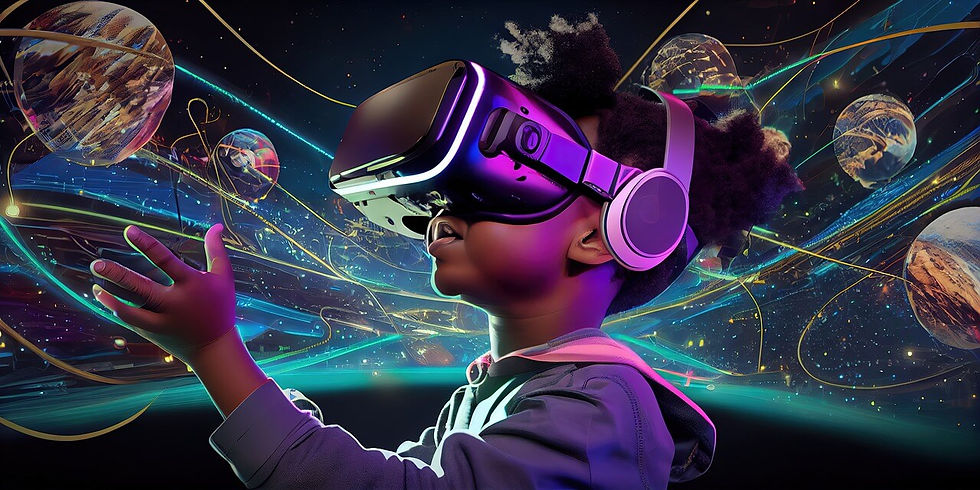
But the full Metaverse experience is unobtainable without some VR/AR/mixed-reality technology. Players may need AR glasses or a VR headset to access some metaverse experiences. A few other metaverses also require you to connect your crypto wallet.
A metaverse without issues?
Albeit a promising development, there are a few concerns about the current developmental state of the Metaverse.
The technology powering the metaverse and its associated hardware are quite expensive. VR headsets retail for as high as $399, which isn't affordable for most people. A strong Internet connection is also ideal, which is lacking in many parts of the world. Powerful computers are also required for some metaverses, which is out of reach of most people.
There are also questions about laws and regulations surrounding the Metaverse. Some experts cite concerns about data security and the potential effects on mental and physical health as well.
Much like the Internet when it was first introduced, the prospects are great. But what will the Metaverse look like in the future?
What does the future hold?
Once AR glasses are here, we’ll only be a step closer to the holoprojectors we saw in movies like Star Wars growing up. The metaverse is here, and it’ll change how we communicate and interact in the future.
There's no way to tell what the Metaverse will look like in the coming years. There could be changes in the way the technology to access the Metaverse works, or changes in how the Metaverse itself looks and functions.
We just don't know.
What is certain is that many metaverses will continue to undergo development. And as the technology improves, so too will the Metaverse. An exciting prospect, indeed.


Comments